
Psychotherapy and counselling in Schools
In Kendal, Windermere, South Lakes and online
I offer individual psychotherapy and counselling for children and adolescents in schools, as well as group nature therapy, calming and coping skills groups for parents and caregivers, and training and wellbeing workshops for school staff.
Sessions can take place indoors or outdoors on school grounds, depending on the needs of the child, group or school.
I am a UKCP-registered Child and Adolescent Psychotherapist and a qualified Primary School Teacher, with over twenty years of experience working with children and young people. I have worked in CAMHS, the NHS, primary and secondary schools, and specialist educational settings.
I bring together my experience of psychotherapy, education, somatic trauma therapy, creative approaches and nature-connected practice to offer individualised support for children, young people and school staff.
Services for Pupils
Individual Psychotherapy and Counselling
I offer one-to-one psychotherapy and psychotherapeutic counselling for children and adolescents within schools.
Sessions can take place indoors, outdoors or as a mixture of both, depending on individual needs, preferences and the spaces available.
I have experience of working with children and adolescents experiencing PTSD, anxiety, depression, grief and loss, selective mutism, separation anxiety, developmental trauma, sexual and physical violence, grooming and ADHD.
I have worked with young people who want to feel more in control of overwhelming emotions, more able to make decisions and hold boundaries, feel more grounded and centred, feel stable and safe, and feel certain about being valuable, capable, lovable, powerful and equal.
As an integrative psychotherapist, I draw on different approaches according to each child's needs. These may include talking therapy, play, art, sandtray, EMDR, movement, mindfulness and nature connection.
We work together to explore what the child or young person would like to be different, what might be helpful and how we can best support them.
Session arrangements
One-to-one sessions are usually weekly and last approximately 50 minutes.
A minimum of ten sessions per child is recommended, with a review every six weeks to reflect on progress, consider the child's current needs and agree on the next steps.
What does the school need to provide?
The school would need to provide:
A private room or secluded outdoor space where sessions can take place without interruption or being overheard.
Suitable referrals, with an initial assessment to explore whether therapy is appropriate for the child or young person.
Opportunities for caregivers and relevant school staff to contribute to the initial assessment, where appropriate.
My provision includes insurance, travel, professional supervision, most therapeutic resources and equipment, and professional body membership costs.
I also offer parent consultations and workshops for parents and teachers to explore ways of supporting children's emotional regulation and developing their own self-regulation skills.
You can read more about my approach on my Child and Adolescent Psychotherapy page.
Group Nature Therapy
Nurture and Nature
The Nurture and Nature therapeutic programme brings together my training and experience in psychotherapy, forest school, ecopsychotherapy, mountain leading and woodland management.
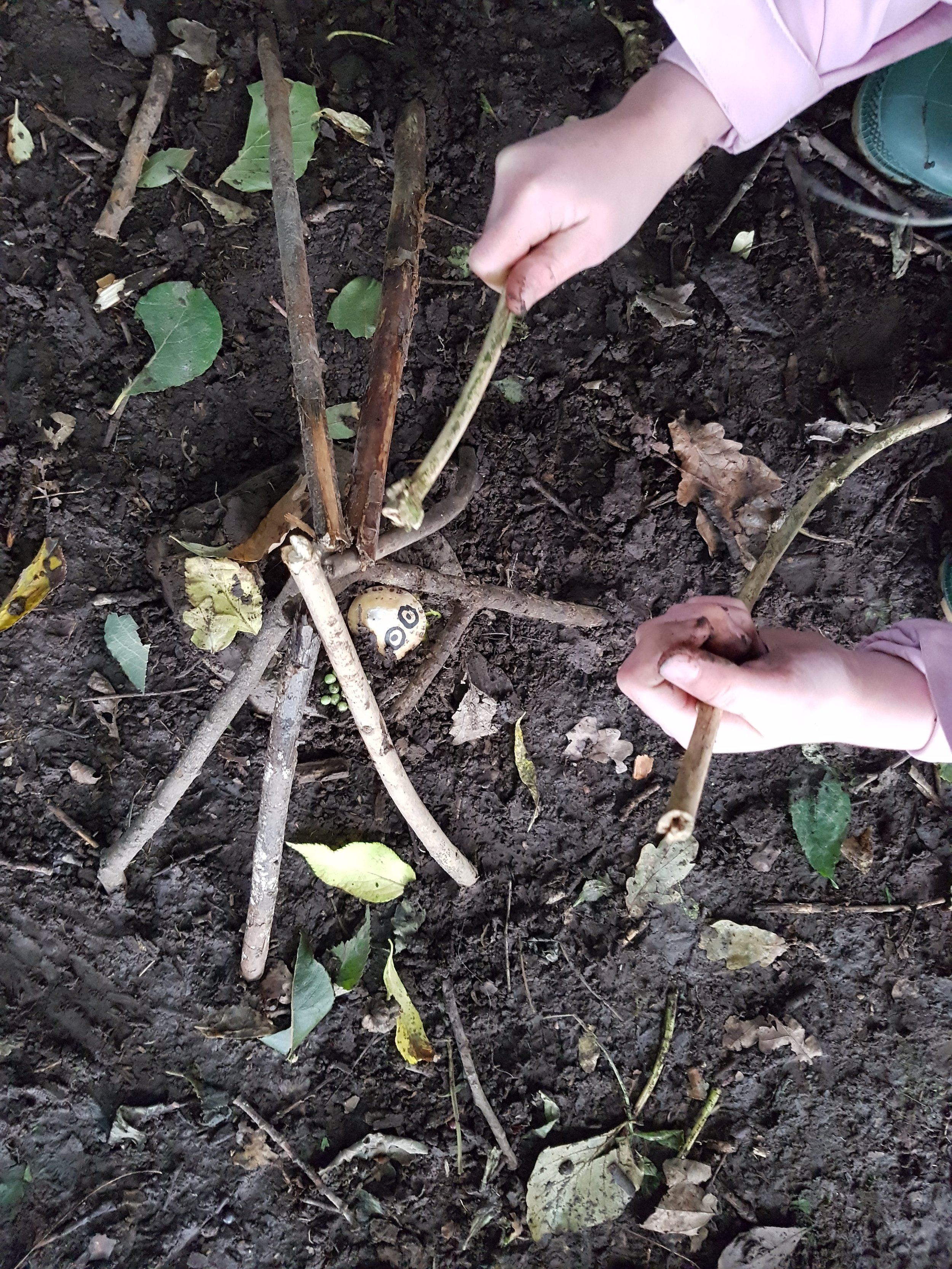
The programme offers children and young people opportunities to develop relationships, emotional regulation, confidence and a sense of connection and belonging through activities in nature.
Each programme is adapted to best suit the group, its needs and the setting.
A typical programme involves weekly two-hour sessions over eight weeks, with a maximum of eight children in each group and a teaching assistant present.
What might the sessions involve?
Sessions offer opportunities to develop:
Relational skills
Body awareness and connection
A supportive, ongoing relationship with nature
Strategies for self-regulation
A sense of connection and belonging
Problem-solving whilst managing overwhelm
Resilience
Boundary setting and consent
Assessing risk
Opportunities for joy, happiness and play
Safe ways of expressing anger, frustration, disappointment and sadness
Autonomy, mastery and self-esteem
Activities are adapted to the needs of the group and might include woodland skills, creative work, movement, sensory awareness, nature connection and opportunities to explore feelings and relationships through shared experiences.
What does the school need to provide?
The school would need to provide a suitable private or secluded outdoor space, with enough room for the group to work without interruption from other classes.
A teaching assistant would need to be present throughout group sessions.
We would discuss referrals and the needs of the children before beginning, to consider whether the group would be suitable for them.
My provision includes insurance, travel, professional supervision, most resources and equipment, outdoor first aid and professional body membership costs.
I carry out site and activity-based risk-benefit assessments ahead of and during sessions.
Groups for Parents and Caregivers
Calming and Coping Skills for Parents and Children
I offer a half-term block of group sessions for parents and caregivers, exploring practical ways to help themselves and their children feel calmer, more stable and better able to cope with difficult emotions.
As parents and caregivers, it can be difficult to support a child who is feeling anxious, angry or overwhelmed, particularly when we are also experiencing stress ourselves. Feeling more stable in our own bodies and emotions can help us to support our children with theirs.
During the sessions, we explore:
How stress, anxiety and overwhelming emotions can affect our minds and bodies.
Understanding our own responses and recognising when we or our children might need some support.
Practical calming and grounding skills using movement, sensory awareness, breathing, creativity and other embodied approaches.
Ways of supporting children to recognise and manage their emotions.
How we can support children to feel calmer and more in control, while also looking after our own wellbeing.
The sessions include opportunities to experiment with different strategies, reflect on what works for you and your child, and consider how to use these in everyday family life.
Group arrangements
The programme runs over a half term, with one group session each week, though this can be adapted to best suit the school. It can be arranged through schools as a group for parents and caregivers.
Sessions can be adapted to suit the needs of the families attending.
Services for School Staff
CPD Training
I offer interactive training for school staff, including:
Psychoeducation and Emotional Regulation
Exploring how trauma, stress and anxiety can affect children and adults, including the role of the nervous system and ways we can support regulation.
Sessions include practical strategies that staff can experiment with in their own lives and in their work with pupils.
Trauma-Informed Practice
Exploring how distressing experiences may influence children's emotions, behaviour, relationships and learning, and how we can respond in ways that support safety, connection and regulation.
Staff Self-Care
Exploring ways of recognising our own stress responses, developing practical self-care strategies and finding opportunities to restore ourselves during and outside the working day.
Sessions can include embodied and creative approaches, as well as opportunities to reflect on what helps and what gets in the way of looking after ourselves.
Wellbeing for School Staff
These sessions offer an opportunity for school staff to spend a few hours or a day exploring different ways of looking after their wellbeing, individually and together.
They can be particularly useful as part of an INSET day, at the start or end of a term or half term.
Sessions are tailored to your needs and can include an individualised combination of woodland skills, yoga, mindfulness and nature-connected activities, such as:
Traditional firelighting
Natural dyeing
Campfire baking and cooking
Yoga
Forest bathing
Mindfulness
Nature-connection activities
Mountain or hill walks
Weaving birdfeeders
The intention is to offer time and space for self-care, relaxation, curiosity and fun, alongside opportunities to explore practices that staff might find useful beyond the workshop.
About Nes

I am a UKCP-registered Child and Adolescent Psychotherapist and Adult Psychotherapeutic Counsellor, as well as a qualified Primary School Teacher and Level 3 Forest School Practitioner.
Before becoming a psychotherapist, I worked in primary education, specialist education and youth work. I have experience of working with neurodivergent children and young people, including those with additional educational and emotional needs.
I am also trained in somatic trauma therapy, EMDR with adults and children, yoga therapy, movement for trauma, and creative approaches to psychotherapy.
Alongside my psychotherapy work, I am a qualified Mountain Leader with training in woodland management and outdoor first aid.
I have experience of facilitating therapeutic outdoor sessions with groups and individuals, as well as training and workshops for teaching staff.
You can read more about my experience and qualifications.
Why outdoors?
Activities in nature can help to increase a feeling of connection and belonging and reclamation of natural spaces and practical skills.
Spending time in nature has been shown to relieve stress and reduce cortisol.
Exposure to green space significantly correlates to a positive effect on well-being[1]
Spending time in nature improves working memory, cognitive flexibility, and attentional control[2]
Contact with nature is associated with increases in happiness, subjective well-being, positive affect, positive social interactions, and a sense of meaning and purpose in life, as well as decreases in mental distress[3]
These sessions will provide the time and opportunity to connect with Nature, to play and to interact with other children, which can otherwise be limited. Connecting with Nature will allow our future generations to understand and value the natural world
[1] White, M. P., Alcock, I., Wheeler, B. W., & Depledge, M. H. (2013). Would You Be Happier Living in a Greener Urban Area? A Fixed-Effects Analysis of Panel Data. Psychological Science, 24(6), 920–928. https://doi.org/10.1177/0956797612464659
[2] Schertz, K. E., & Berman, M. G. (2019). Understanding Nature and Its Cognitive Benefits. Current Directions in Psychological Science, 28(5), 496–502. https://doi.org/10.1177/0963721419854100
[3] Bratman GN, Anderson CB, Berman MG, Cochran B, de Vries S, Flanders J, Folke C, Frumkin H, Gross JJ, Hartig T, Kahn PH Jr, Kuo M, Lawler JJ, Levin PS, Lindahl T, Meyer-Lindenberg A, Mitchell R, Ouyang Z, Roe J, Scarlett L, Smith JR, van den Bosch M, Wheeler BW, White MP, Zheng H, Daily GC. Nature and mental health: An ecosystem service perspective. Sci Adv. 2019 Jul 24;5(7):eaax0903. doi: 10.1126/sciadv.aax0903. PMID: 31355340; PMCID: PMC6656547.