
Eco-therapy/ nature therapy
in Staveley, Kendal and online
Eco Therapy
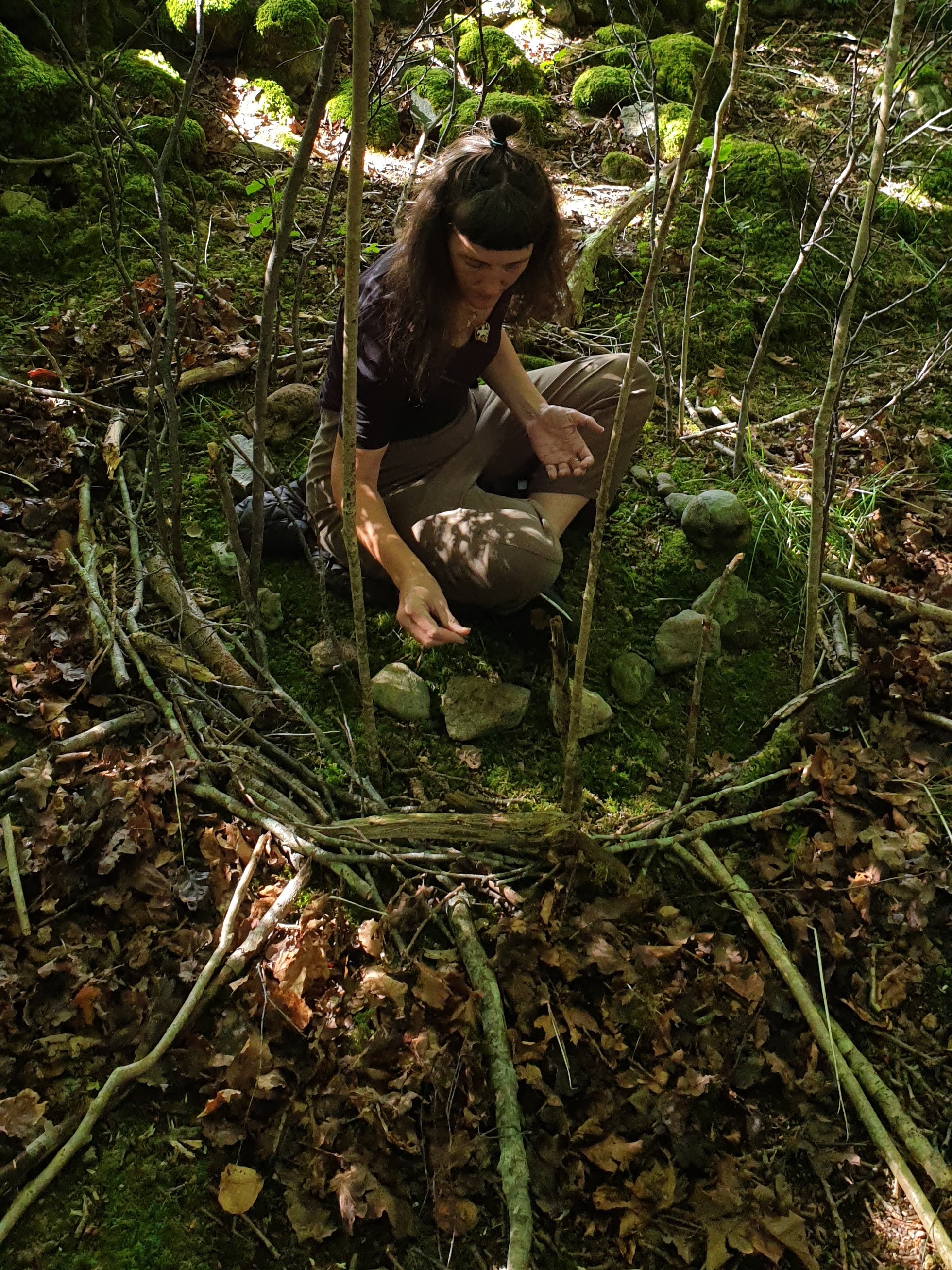
All my psychotherapy and yoga therapy sessions take place with an awareness of and reconnection with the wider world and its inhabitants. However, in these specific ecotherapy sessions, my role becomes more of a facilitator in helping you to develop a deeper connection with more-than-human nature.
I may suggest a variety of activities and ways of working to help develop and support that relationship, which can deepen self-awareness, embodied connection and a sense of belonging.
As an ecopsychotherapist, I combine psychotherapeutic counselling with nature connection, offering sessions outdoors in woodlands, meadows, lanes and fells in the South Lakes.
What might an ecotherapy session involve?
As a Mountain Leader, I also offer walk-and-talk sessions, which combine movement and nature connection with talking therapy, in the Lake District National Park.
Sometimes sessions are slow or static, sometimes moving, sometimes in woodlands and sometimes in the fells. We may walk, stop for a while, or work in one place before moving somewhere else.
The other-than-human world can take a more active role in our sessions, and we may explore specific nature-connecting activities, such as therapeutic land art, mindfulness and grounding.
We usually decide on a walk and a pace together that feels right for you on that day. Activities and ways of working are individualised according to what would be helpful for you.
One-off or regular sessions
These sessions can take place as a one-off or more regularly.
They can involve working together to create an individualised practice of nature and body reconnection that you can continue outside of our sessions.
You may then choose to have no further sessions, occasional sessions to adapt or develop your practice, or regular sessions of exploration and connection if this would best support your needs.
Ecotherapy and nature connection can also be integrated into longer-term psychotherapeutic counselling.
Eco-anxiety and climate concerns
I understand how concerns about climate change and the future, including eco-anxiety, can feel overwhelming.
In our sessions, I offer a space to explore these feelings, process your fears, and find ways to stay grounded, connected and able to live in line with your values.
Practical information
Location
Ecotherapy sessions usually take place in the woodlands, meadows, lanes and fells around Staveley in the South Lakes.
We can discuss what setting and type of session would work best for you in our initial meeting, and change or adapt this depending on your needs and preferences.
Session length
Individual sessions are 50 minutes.
Initial consultation
Before our first outdoor session, I request an initial online consultation to find out a little about you and your hopes and needs. We can then discuss how we might work together and arrange our outdoor session or sessions.
Fees
Please see my current therapy fees and sliding-scale information or get in touch to discuss the cost of ecotherapy sessions.
Group Sessions
I also offer public and privately booked sessions in nature reconnection.
For public sessions, please see my Events page.
To arrange a session for your own private group, please get in touch.
DIY
You could also experiment with embodied nature reconnection using my Wild & Well-Being Card Deck: 70 Exercises for Nature-Based Self Care, published by W. W. Norton.
Available at most bookshops, including:
Why outdoors?
Activities in Nature can help to increase a feeling of connection and belonging and reclamation of natural spaces and practical skills.
Spending time in Nature has been shown to relieve stress and reduce cortisol.
Exposure to green space significantly correlates to a positive effect on well-being[1]
Spending time in Nature improves working memory, cognitive flexibility, and attentional control[2]
Contact with Nature is associated with increases in happiness, subjective well-being, positive affect, positive social interactions, and a sense of meaning and purpose in life, as well as decreases in mental distress[3]
[1] White, M. P., Alcock, I., Wheeler, B. W., & Depledge, M. H. (2013). Would You Be Happier Living in a Greener Urban Area? A Fixed-Effects Analysis of Panel Data. Psychological Science, 24(6), 920–928. https://doi.org/10.1177/0956797612464659
[2] Schertz, K. E., & Berman, M. G. (2019). Understanding Nature and Its Cognitive Benefits. Current Directions in Psychological Science, 28(5), 496–502. https://doi.org/10.1177/0963721419854100
[3] Bratman GN, Anderson CB, Berman MG, Cochran B, de Vries S, Flanders J, Folke C, Frumkin H, Gross JJ, Hartig T, Kahn PH Jr, Kuo M, Lawler JJ, Levin PS, Lindahl T, Meyer-Lindenberg A, Mitchell R, Ouyang Z, Roe J, Scarlett L, Smith JR, van den Bosch M, Wheeler BW, White MP, Zheng H, Daily GC. Nature and mental health: An ecosystem service perspective. Sci Adv. 2019 Jul 24;5(7):eaax0903. doi: 10.1126/sciadv.aax0903. PMID: 31355340; PMCID: PMC6656547.